Algorithms of Hope: Why India’s AI Future Must Serve Its Most Marginalized Voices
AI is no longer a distant technology; it is part of the story the country is telling about itself.
A new kind of email from the PMO When an email lands in your inbox saying, “Get your hands on what India achieved this month ! AI Summit, winning stories & much more on Mann Ki Baat,” it is not just another government circular — it is a signal of what New India is preparing for. The Prime Minister’s Office using its official outreach channel to highlight an AI Summit alongside Mann Ki Baat shows that artificial intelligence has moved from niche policy discussions into the centre of India’s public conversation. For entrepreneurs, MSMEs, students, and ordinary citizens, this framing is important :
AI is no longer a distant technology; it is part of the story the country is telling about itself.
Inside the India AI Impact Summit 2026 The India AI Impact Summit 2026 was held at Bharat Mandapam in New Delhi and is being described by the government as the world’s largest historic AI Impact Summit, with participation from over 100 countries. It brought together heads of state, global tech CEOs, researchers, policymakers, and startups under the IndiaAI Mission, with sessions structured around three pillars: People, Planet, and Progress. This isn’t just a tech expo; it is positioned as a global platform from the Global South to shape how AI will drive inclusive growth, public service delivery, and sustainable development.
The India AI Impact Summit 2026 was held at Bharat Mandapam in New Delhi and is being described by the government as the world’s largest historic AI Impact Summit
M.A.N.A.V: India’s human-centric AI vision At the summit, the Prime Minister presented India’s M.A.N.A.V. vision for AI — Moral and Ethical Systems, Accountable Governance, National Sovereignty, Accessible and Inclusive, and Valid and Legitimate — framing AI as a “human-centric” force, not a machine-centric one. He linked this vision to the summit theme “Sarvajan Hitaya, Sarvajan Sukhaya” (Welfare for all, Happiness for all), clearly stating that AI must not reduce humans to mere data points but must empower especially the
Global South. The message is simple but powerful: AI should be democratized, open, and shared — making India a natural hub for affordable, scalable, and secure AI solutions that can work in multilingual, diverse environments.
Mann Ki Baat: AI as a turning point In his Mann Ki Baat address around the same time, the Prime Minister described the India AI Impact Summit as a “turning point” in how the world will utilize the power of artificial intelligence going forward. He highlighted that global leaders were impressed by India’s AI breakthroughs and the launch of three Made-in-India AI models and apps, emphasizing that India is no longer just a user but a creator shaping global AI conversations. The radio address connected AI progress with broader national achievements — from agriculture to digital inclusion — signaling that AI is being woven into the narrative of India’s development journey.
Numbers, scale and global attention Official communications describe the summit and its expo as bringing together more than 500 global AI leaders, including around 100 CEOs and founders, 150 academicians and researchers, and hundreds of technology and policy leaders. Press coverage notes that the India AI Impact Expo and Summit were projected to attract lakhs of visitors and thousands of applications for AI challenges, with final teams from over 60 countries presenting solutions at Bharat Mandapam. For India, this scale is being framed as proof that the country’s tech ecosystem — semiconductors, data centers, startups, and quantum research — is ready to support AI innovation for both domestic needs and global markets.
For India, this scale is being framed as proof that the country’s tech ecosystem — semiconductors, data centers, startups, and quantum research — is ready to support AI innovation for both domestic needs and global markets.
Story: A Lucknow MSME founder at Bharat Mandapam Imagine a small textile exporter from Lucknow — let’s call her Kavita — reaching Bharat Mandapam for the first time. She is used to bargaining at Chowk, arguing with shipping agents, and decoding confusing emails from overseas buyers; AI, for her, has always sounded like something meant for Silicon Valley, not for her cramped workshop with ten sewing machines. At the summit’s MSME-focused pavilion, she watches a simple demo: an AI model that can translate her Hindi voice notes into fluent English product descriptions, generate catalogue-ready images, and even suggest export-friendly pricing based on market data.
In ten minutes, Kavita sees what earlier required a full marketing team: product copy, basic design, and negotiation support bundled into a friendly chat interface. On a nearby screen, another tool shows how AI can read GST invoices and bank statements to generate a cash-flow view, helping her talk more confidently to the bank manager about working capital. For the first time, she feels that “Digital India” is not only about big platforms but about making her everyday business less dependent on middlemen.
Opportunity and risk: The two faces of AI While celebrating AI’s promise, the Prime Minister has also used his public platforms to warn citizens about rising digital frauds, including so‑called “digital arrests” where scammers impersonate law enforcement or financial authorities. He has urged people — particularly senior citizens and small business owners — to stay alert and to complete KYC or financial verifications only through trusted banking channels, not through random links or unofficial calls. This double message — AI as opportunity and AI-era fraud as a danger — captures the new reality in India: digital empowerment and digital exploitation are growing side by side.
To make this real, think of a retired government employee in Kanpur who receives a call claiming that his Aadhaar is “blocked” and that he must screen-share his phone to avoid a “digital arrest”. In an AI-saturated world where deepfakes, cloned voices, and realistic fake videos are becoming easier to produce, such scams will only get more convincing. That is why the push for “safe and trusted AI” at the summit — one of the seven working group themes — is not academic; it is about protecting people’s life savings and dignity.
That is why the push for “safe and trusted AI” at the summit — one of the seven working group themes — is not academic; it is about protecting people’s life savings and dignity.
The following comparison highlights the difference between India’s stated AI vision, as presented at the Summit and in Mann Ki Baat, and the typical framing of AI in the Global North:
Strategic Lens
- India: Views AI as a Global Common Good, intended to be shared and democratized for the Global
- South.
- Global North: Tends to frame AI as a strategic, often proprietary asset and a source of competitive
- advantage.
Core Narrative
- India: Focuses on being Human-centric, inclusive, and driven by the principle of “Sarvajan Hitaya,
- Sarvajan Sukhaya” (Welfare for all, Happiness for all).
- Global North: Generally centers on Innovation-centricity, productivity, and defense applications.
Openness
- India: Emphasizes open code, shared innovation, and broad youth participation.
- Global North: Places more emphasis on closed models and Intellectual Property (IP)-heavy ecosystems.
Development Focus
- India: Prioritizes development in Agriculture, healthcare, governance, inclusion, and multilingual
- solutions.
- Global North: Concentrates on high-value enterprise use cases, automation, and efficiency.
This framing does not mean the Global North is “bad” and India is “pure”, but it does highlight a deliberate attempt by India to own the narrative of AI as a tool for inclusion, not only profit. For Indian founders and MSMEs, aligning products and stories with this human‑centric, inclusive framing can unlock easier partnerships with government program , development agencies and global impact funds.
AI for MSMEs, students and Bharat’s real economy Summit documentation and official speeches repeatedly emphasize AI for economic growth and social good, democratizing AI resources, inclusion for social empowerment, and human capital development. The India AI Impact Summit is structured so that startups, researchers and policymakers collectively work on agriculture, public health, education, employment and green growth, not only consumer apps and marketing tools. For MSMEs, this means three big opportunity zones:
AI for market access (exports, e‑commerce, multilingual marketing),
AI for productivity (automation of paperwork, inventory, payments), and
AI for skilling (vernacular learning tools for workers). Students and youth are placed at the centre of this narrative: the summit’s communication highlights strong participation from young innovators, hackathon finalists, and campus teams from across India and the world. This focus matches the PMO’s social media messaging, which talks about “our time has come in AI” and projects India’s youth as the backbone of this transformation. If India can combine policy support, affordable compute, and vernacular-first AI tools, the country can turn its demographic advantage into a genuine AI workforce advantage.
AI for productivity (automation of paperwork, inventory, payments),
Story: Two India's in one AI future On one side of the summit hall, a young engineer from Bengaluru is showcasing a model that can generate synthetic training data for agri-tech startups, winning praise from global investors. On the other side of the city, a delivery rider in Najafgarh is trying to understand why an app has silently reduced his per‑ride payout, driven by some opaque “AI optimisation” that no one has explained to him. Both are living in the same AI-powered India — but one is shaping the algorithm, and the other is being shaped by it. This is where storytelling, public debate, and social awareness become critical. If AI benefits are to truly reach “Sarvajan”, then workers, farmers, self‑help group members, and gig workers must have a voice in how algorithms rate, rank, and reward them. The summit’s talk of ethics, accountability and human‑centric design will only matter if civil society, media, and storytellers keep translating these high-level principles into real-life questions.
What this means for your content and digital strategy For digital marketers, bloggers, and founders, the PMO’s focus on AI and Mann Ki Baat opens a powerful content opportunity: connect policy, technology, and lived reality in one narrative. Content that explains India’s AI journey while telling grounded stories of farmers, shopkeepers, teachers, and students will rank better and resonate deeper than generic “Top 10 AI Tools” style articles.
If you create Hindi-first or bilingual content, you are especially well placed, because both the summit and Mann Ki Baat underline multilingual, inclusive AI as a strategic priority for India. From an SEO perspective, structuring your blog around clusters like “India AI Impact Summit 2026”, “Mann Ki Baat AI”, “AI for MSMEs in India”, “human-centric AI”, and “AI for Global South” can help you tap into rising search interest sparked by this event. Add internal links to related posts on digital fraud awareness, AI tools for small businesses, and government schemes for MSMEs to deepen session time and topical authority. Over time, this positions your platform as a go‑to explainer of how big national tech narratives translate into practical, everyday advantages — or dangers — for ordinary Indians.
The startup positions itself as a Hindi‑first, Swadeshi AI and digital growth platform designed specifically for the 50+ million small and offline business owners who have been left out of complex, English‑centric software.
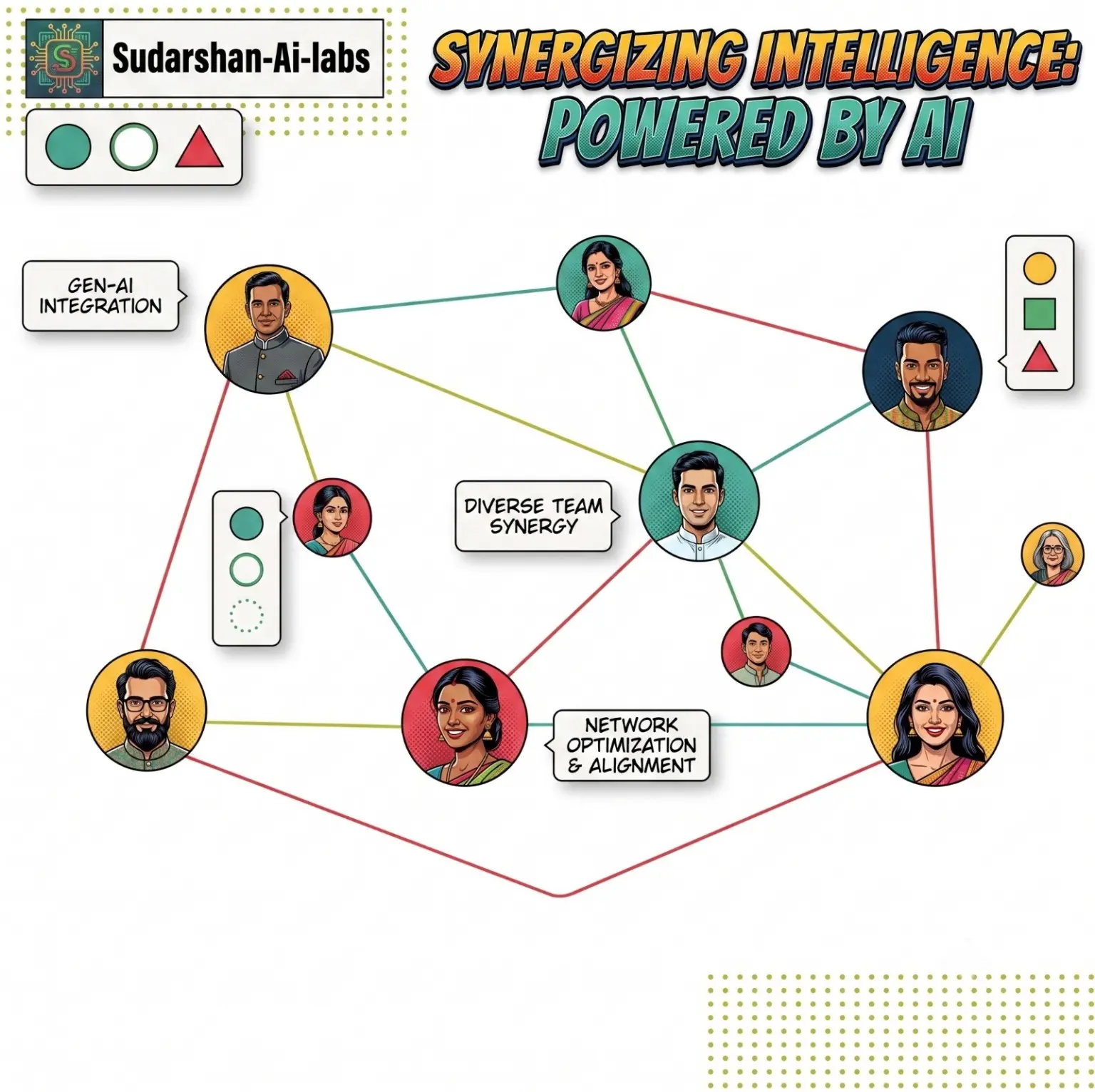
Sudarshan AI Labs: Bharat-first AI in action While the India AI Impact Summit spoke about making AI human‑centric, inclusive and focused on the Global South, Lucknow‑based NAVA‑NETRA NEURAL Sudarshan AI Labs is already building exactly that for Indian MSMEs. The startup positions itself as a Hindi‑first, Swadeshi AI and digital growth platform designed specifically for the 50+ million small and offline business owners who have been left out of complex, English‑centric software. Sudarshan AI Labs’ mission, summed up in the line “Vyapaar ka AI Yug — हर दुकानदार की ड ज ल क्रां त”, is to use no‑code and low‑code AI tools to bring every chai stall, kirana store, tailor, salon and micro‑enterprise into the digital economy. Its platform offers ultra‑affordable digital storefronts starting at around ₹89, vernacular CRM, WhatsApp‑native communication, AI‑generated local marketing content, and automation for invoices, UDYAM support and GST‑ready billing — mirroring the summit’s call to democratize AI and use it for economic growth and social good. Just as the summit emphasizes AI for MSMEs, inclusion and human capital, Sudarshan AI Labs explicitly targets Tier‑2 and Tier‑3 cities, focusing on Hindi‑speaking states like Uttar Pradesh and neighboring regions, and builds tools that work on low bandwidth, mobile‑first devices.
By centering language, affordability and simplicity, it operationalizes the summit’s idea that any AI model that succeeds in India’s diversity can succeed globally — turning high‑level policy talk into real dashboards, reminders and revenue for small shopkeepers.
By centering language, affordability and simplicity, it operationalizes the summit’s idea that any AI model that succeeds in India’s diversity can succeed globally — turning high‑level policy talk into real dashboards, reminders and revenue for small shopkeepers. Press and ecosystem descriptions of Sudarshan AI Labs highlight how its Hindi‑first AI ecosystem aligns with Digital India and Atmanirbhar Bharat, helping formalize the informal economy and increase MSME contribution to GDP. This direct alignment between national missions and a ground‑level startup makes Sudarshan AI Labs a living example of “AI for Global Common Good” starting from mohalla markets, not just from corporate boardrooms.
Author :
-Sheevum Goel