It’s a catastrophic, balance-sheet-burning error. It’s not a flaw in their media buying, their creative direction, or their digital prowess. It’s a fundamental misunderstanding of geography, culture, and humanity. They believe a campaign that wins awards at a South Mumbai gala will win customers in Kanpur. This is the "One-Size-Fits-All" fallacy, and it’s where national campaigns come to die. Uttar Pradesh is not just India’s most populous state; it is a 'desh' (nation) in itself, a complex tapestry of dialects, traditions, and consumer behaviors that simply doesn’t compute with the "Mumbai Gaze." For decades, brands have pumped astronomical budgets into pan-India campaigns designed in glass towers, expecting them to resonate in the gallis of Agra and the chaupals of Gorakhpur. The result? Wasted ad spend, weak market penetration, and a profound disconnect with the real customer. This article dissects why this failure is so consistent and why cultural marketing, driven by local expertise, is the only antidote.
Bridging the Gap: About Sudarshan AI Labs
The "One India" Illusion: Why a Monolithic Strategy Fails
The core of the problem lies in a convenient illusion: that urbanization, data plans, and Bollywood have homogenized India. Mumbai, as the epicenter of finance and media, often projects its own fast-paced, individualistic, and globally-influenced culture onto the rest of the nation. But the consumer psyche in UP operates on a completely different OS. * Mumbai Mindset : Aspirations are often individualistic. Success is defined by career growth, lifestyle upgrades, and global trends. The marketing language is "Hinglish," peppered with English buzzwords. * UP Mindset:
Aspirations are community-centric. Success is tied to family well-being, social standing, respect, and upholding tradition. The language is not just Hindi; it’s a rich spectrum of Awadhi, Bhojpuri, Braj, and Khari Boli, where lehza (tone) and respect are paramount. A Mumbai agency might create an ad for a new fintech app highlighting "individual financial freedom." In UP, that same app needs to be marketed as a tool for "securing the family’s future" or "making the community proud." The first message is noise; the second is a conversation.
The High Cost of Cultural Disconnect: Where Campaigns Collapse
When regional marketing is ignored, the failure isn’t subtle. It’s a spectacular crash, and here’s exactly where it happens. 1. Misunderstanding the Asli Consumer Psyche The UP consumer is not a "user" or a "demo." They are a member of a dense social fabric. Their purchase decisions are heavily influenced by a complex web of relationships. The Family Unit: The decision-maker for a high-value purchase (like a tractor or a smartphone) might not be the user (the son) but the financier (the father) or the influencer (the mother). Ads that celebrate youthful rebellion or extreme individualism often backfire, as they are seen as disrespectful to family values. The "Bhaiyaji" Factor: Commerce in UP is built on relationships. The local retailer ("Bhaiyaji") is not just a vendor; he’s a trusted advisor, a community figure. A slick, impersonal ad campaign holds zero weight against a simple "Yeh naya product bekaar hai" (This new product is useless) from the local shopkeeper. Mumbai-based strategies often bypass this crucial human channel, focusing purely on D2C or large-format retail, thereby missing the artery of local commerce. 2. Language vs. Lehza: Beyond Simple Translation This is the most common pitfall. Agencies believe translating their English or Hinglish copy into standard Hindi is enough. It’s not. The problem isn’t the word; it’s the music. The "Aap" vs. "Tu" Minefield: In Mumbai’s casual culture, "tu" can be a term of endearment. In UP, using "tu" for a stranger or elder is a profound insult. A friendly, "cool" ad can be perceived as "badtameez" (ill- mannered) within seconds. Humor Doesn’t Travel: Sarcasm, irony, and self-deprecating humor—staples of urban advertising—do not land well. Humor in UP is more direct, situational, and community-based. A campaign that’s "witty" in Bandra is often just "confusing" or "offensive" in Bareilly. The Wrong Metaphors: An ad for a car might show a lone driver on a coastal highway, a metaphor for freedom. In UP, a car is a family asset. The winning metaphor is a family of five driving to a wedding or a temple, a symbol of prosperity and togetherness. 3. Ignoring the "Real" Media Channels While it’s true that data is cheap and everyone is on YouTube, how they use it is different. A Mumbai agency might prioritize Instagram Reels and targeted programmatic ads. But in UP, the digital ecosystem is different. The WhatsApp Ecosystem: Information, news, and (most importantly) recommendations travel through WhatsApp. A "viral" ad is one that is shared in family and locality groups. Local Influencers: The "influencer" isn’t a fashion blogger. It’s the local news reporter, the popular katha- vachak (religious storyteller), or the tech reviewer who explains things in simple, local Hindi on their YouTube channel. Offline Still Reigns: The power of a wall painting, a nukkad natak (street play) at a local fair, or a sponsorship of a community cricket tournament far outweighs a poorly targeted digital banner.
The Solution: Hyper-Localization & Cultural Marketing
The ₹100 crore mistake is avoidable. The solution is to stop projecting and start listening. This is the essence of cultural marketing. Regional marketing is not about having a separate budget for UP. It’s about having a separate brain. It’s about accepting that what works in one part of India is irrelevant in another.
Winning in UP requires: Boots on the Ground:
You cannot understand a market from 1,400 km away. You need local expertise—a team that lives, breathes, and understands the cultural nuances because it is their culture.
Building Trust, Not Buzz:
The goal is not to "disrupt." The goal is to "belong." Brands must align with local values of family, respect, and community.
Speaking the Right Language:
This means investing in creatives developed from the local dialect, not just translated into it.
Leveraging the Real Network:
Engage with local micro-influencers, build relationships with retailers, and show up at community events.
Bridging the Gap: About Sudarshan AI Labs
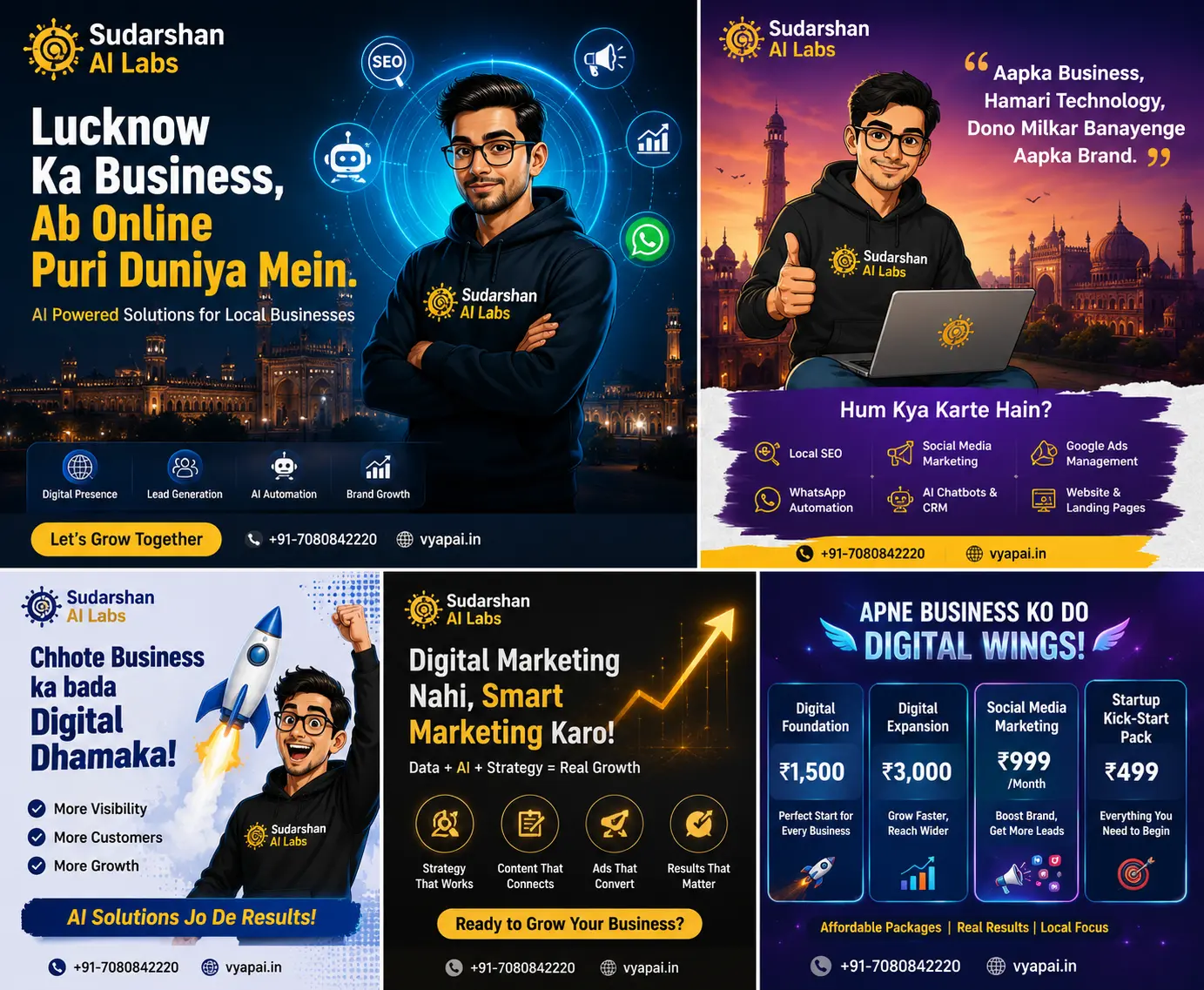
This is precisely why Sudarshan AI Labs was founded. Based in the heart of Uttar Pradesh—Lucknow—we were built to solve this exact problem. We are not an outside agency guessing about the UP market. We are the UP market. Sudarshan AI Labs exists to power the digital growth of India’s micro, offline, and MSME business owners. We understand that the "Bhaiyaji" at the corner store and the small-town manufacturer are the backbone of our economy. They don’t need slick campaigns from Mumbai; they need intelligent, respectful, and effective digital strategies that speak their language and honor their customers. We leverage AI-driven insights to understand the local pulse at a granular level. We don’t just translate; we trans-create. We build digital solutions, content, and marketing strategies that are culturally native to the heartland. We help brands bridge the gap between their national ambition and the local reality, ensuring their message isn’t just seen but felt and accepted.
The Final Word:
Stop Guessing, Start Connecting The ₹100 crore mistake is, at its heart, a mistake of arrogance. It’s the assumption that a single, centralized idea can capture the hearts and minds of 1.4 billion people. Uttar Pradesh is not a "market to be captured." It’s a "culture to be understood." The brands that continue to ignore this will see their budgets evaporate. The future of marketing in India is not national; it’s hyper-local. To win here, you don’t need a bigger budget. You need a better partner—one with local expertise built into its DNA. Stop making the mistake. Stop viewing UP as just another pin on a map. Start engaging with the real heart of India, on its own terms.